
Introduction
In today’s highly competitive education sector, attracting students is no longer about traditional advertising like newspaper ads or pamphlets. Schools, universities, coaching institutes, and EdTech companies now compete in a digital-first environment where students and parents research, compare, and decide online.
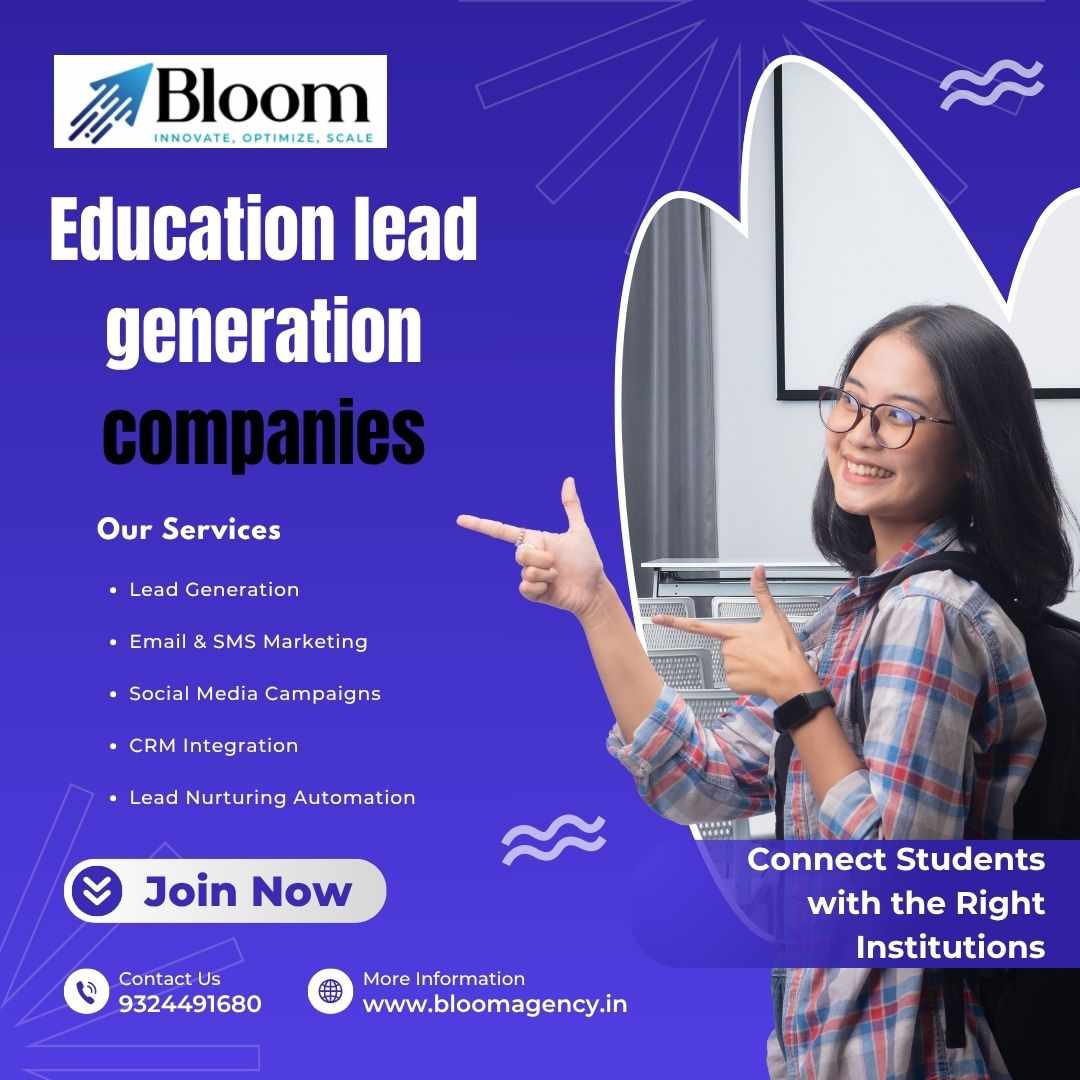
This shift has made educational lead generation one of the most important growth strategies for institutions. Agencies like Bloom Agency specialize in building structured systems that generate, filter, and convert student interest into actual admissions.
What Is Educational Lead Generation?
Educational lead generation is the process of attracting potential students (or parents/decision-makers) and converting their interest into actionable inquiries such as:
Course registrations
Admission form submissions
Counseling requests
Campus visit bookings
Instead of waiting for walk-ins or referrals, institutions actively create demand through digital channels and capture high-intent prospects.
The goal is not just more leads, but better-quality admissions-ready leads.
Why Educational Institutions Need Lead Generation Systems
The education market has changed dramatically due to:
1. Increased Competition
Thousands of institutions offer similar programs, making differentiation harder.
2. Digital Decision-Making
Students compare courses on:
Google search
YouTube
Instagram
Review platforms
3. Longer Decision Cycles
Parents and students often take weeks or months before finalizing admissions.
4. Rising Marketing Costs
Random advertising without targeting leads to wasted budgets.
Because of these factors, structured lead generation systems are now essential for predictable admissions.
How Bloom Agency Approaches Educational Lead Generation
Bloom Agency focuses on building a full-funnel admission system rather than just running ads.
1. Audience Research & Segmentation
The first step is understanding:
Student demographics (age, location, education level)
Decision makers (students vs parents)
Career goals (engineering, management, healthcare, etc.)
Behavioral triggers (exam results, deadlines, career shifts)
This helps create highly targeted campaigns instead of broad advertising.
2. Multi-Channel Marketing Strategy
Instead of depending on one platform, campaigns are spread across:
Search engines (SEO & Google Ads)
Social media (Instagram, Facebook, LinkedIn)
Content marketing (blogs, landing pages)
Video marketing (YouTube, reels, webinars)
Email & WhatsApp campaigns
This ensures institutions reach students at multiple touchpoints during their decision journey.
3. High-Converting Landing Pages
Traffic alone is not enough. Bloom-style systems focus on:
Dedicated course landing pages
Clear admission forms
Strong call-to-action buttons
Program highlights (placements, rankings, faculty)
These pages are optimized to convert visitors into leads.
4. Lead Qualification & Filtering
One major challenge in education marketing is low-quality inquiries.
To solve this, leads are filtered based on:
Course interest
Location eligibility
Budget range
Academic background
This ensures counselors spend time only on serious prospects.
5. Automated Lead Nurturing
Most students don’t convert immediately. So institutions use:
Email follow-ups
WhatsApp reminders
SMS notifications
Counseling call sequences
This keeps students engaged until admission decisions are made.
6. Performance Tracking & Optimization
Campaign performance is continuously measured using:
Cost per lead (CPL)
Conversion rate (lead to admission)
Channel performance
Student behavior tracking
Based on data, campaigns are optimized in real time.
Benefits for Schools, Universities & EdTech Companies
With a structured system like this, institutions typically experience:
✔ Higher Quality Admissions
More genuine students instead of random inquiries.
✔ Lower Cost Per Admission
Better targeting reduces wasted ad spend.
✔ Predictable Enrollment Pipeline
Institutions can forecast admissions more accurately.
✔ Improved Counselor Efficiency
Counselors spend time on serious leads only.
✔ Scalable Growth
Campaigns can be scaled across multiple programs and campuses.
Example Use Cases
Schools & Colleges
Admission campaigns for new academic sessions
Local student targeting
Parent-focused awareness campaigns
Universities
Program-specific lead generation (MBA, B.Tech, etc.)
National and international student outreach
EdTech Companies
Enrollment for online courses
Webinar-based lead capture
Subscription-based learning platforms
Why Education Lead Generation Is Different
Unlike regular industries, education marketing involves:
Emotional decision-making (career + future)
Multiple stakeholders (students + parents + counselors)
Long consideration periods
Trust-based conversions
This makes it essential to use specialized education-focused strategies rather than generic marketing.
Conclusion
Educational lead generation company is now a core growth engine for schools, universities, and EdTech platforms. Agencies like Bloom Agency help institutions move beyond traditional marketing and build structured digital systems that consistently generate admissions.
The key shift is simple:
From random inquiries → to predictable admissions pipeline



Write a comment ...